Automate Invoicing for HK SMEs Without Expensive Software
The 2-Hour Weekly Drain: Why Manual Invoicing Is Costing Your HK Business
If you are running a small trading or service company in Hong Kong, you already know the routine. The week ends, the goods are delivered or the project is finalized, and suddenly you are faced with a familiar administrative mountain: drafting invoices, cross-referencing purchase orders, sending them to clients, and then playing detective to match incoming bank transfers to the correct bills. For a lean two-person team, this easily consumes two to three hours every single week. That might not sound like much until you realize those hours accumulate to over one hundred hours annually. That is valuable time that could be spent closing new deals, optimizing your supply chain, or simply taking a much-needed weekend off.
Many business owners attempt to solve this bottleneck by subscribing to enterprise-grade accounting platforms. However, for Hong Kong SMEs, that path frequently leads to another layer of frustration. The software is expensive, demands a steep learning curve, and critically, rarely integrates smoothly with local banking ecosystems. You end up paying premium subscription fees while still manually reconciling payments from local banks or standard payment gateways. There is a fundamentally better way forward.
Why Traditional Accounting Platforms Fall Short for Local SMEs
The assumption that every business requires a full-stack accounting suite is an outdated myth. For a compact team operating in Hong Kong’s fast-paced commercial environment, the priority is cash flow visibility and operational velocity, not complex inventory modules or global tax compliance features that will never be utilized. Traditional platforms were engineered for a broad international market. They often lack native support for Hong Kong’s specific banking file formats, local invoice numbering conventions, and the preferred regional payment methods like FPS, PayMe, or WeChat Pay HK.
When integration is clunky, you inevitably become the manual bridge. You export CSV statements from your business account, manually format them to match your accounting software, and spend evenings staring at mismatched transaction references. Subscription costs escalate as you add team members, and technical support is rarely optimized for regional operational nuances. This is not merely an inconvenience; it is a structural bottleneck that prevents small businesses from scaling efficiently. The critical question is not which expensive platform to purchase, but how to architect a lightweight, automated workflow that executes exactly what your business requires, without the unnecessary bloat.
The Modern Solution: AI-Powered Workflow Automation
Instead of forcing your daily operations into a rigid, one-size-fits-all software ecosystem, progressive Hong Kong SMEs are adopting modular AI automation. This methodology connects your existing operational tools—email, cloud storage, banking portals, and communication applications—through intelligent workflows that execute repetitive tasks autonomously. At its foundation, this is not about replacing human oversight. It is about systematically eliminating friction from predictable, rule-driven processes so you can dedicate your focus to strategic decision-making and client relationships.
Step 1: Intelligent Document Extraction
The primary bottleneck in any invoicing pipeline is manual data entry. Every time you receive a purchase order, a supplier statement, or a client email containing attached PDFs, your team has to manually input dates, amounts, company identifiers, and line-item details. Modern optical character recognition combined with large language models completely transforms this workflow. You can configure an automation sequence where incoming emails with attachments are automatically ingested and scanned. The AI extracts structured data, validates it against your internal pricing templates, and populates a clean, centralized database. Copy-pasting becomes obsolete. Typographical errors disappear. You receive accurate, ready-to-process data directly on your operational dashboard.
Step 2: Automated Payment Reconciliation
Tracking outstanding balances is where traditional manual processes fracture. With automated workflows, you can schedule secure bank statement imports at defined intervals. The system parses incoming transaction metadata, matches them against pending invoices using client names, reference codes, and exact or partial amounts, and automatically flags any discrepancies. When a Fast Payment System transfer arrives with a matching identifier, the workflow instantly marks the invoice as settled, updates your real-time cash flow tracker, and archives the transaction log. Partial payments or ambiguous references are seamlessly routed to a simplified review queue, allowing you to approve or adjust them in seconds rather than searching through fragmented spreadsheets.
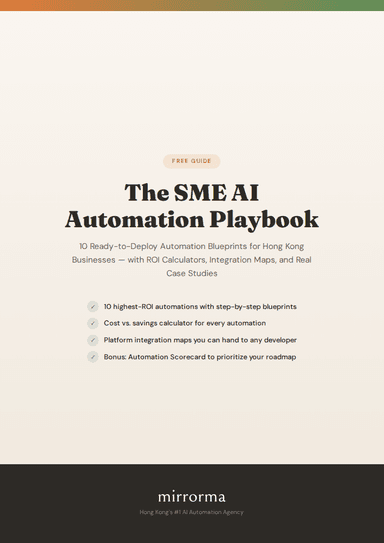
Stop Guessing. Start Automating.
Get the exact blueprints, ROI calculators, and integration maps behind 10 proven automations — the same playbook we use to save Hong Kong businesses 10-20 hours every week. Calculate your savings before you spend a dollar.
Instant download. No spam. Unsubscribe anytime.
Join 500+ Hong Kong business owners
Step 3: Smart Follow-Ups and Client Communication
Overdue receivables are an industry-wide challenge, but chasing them should not damage client rapport or consume your working hours. AI-driven workflows can continuously monitor invoice maturity dates and automatically dispatch polite, professionally formatted reminders via email or WhatsApp. The communication tone can be dynamically adjusted based on your historical relationship with the client, while escalation protocols ensure that severely delayed invoices are immediately flagged for your personal intervention. This maintains steady cash flow without forcing you to adopt the uncomfortable role of a collections agent.
Practical Takeaways: Building Your Automation Stack in Four Steps
Transitioning from fragmented manual invoicing to a cohesive AI-assisted workflow does not require a massive capital investment or an in-house development department. Implement this proven framework within your Hong Kong business to see immediate operational gains:
- Map Your Current Process: Document every single step from initial order confirmation to final payment receipt. Pinpoint exactly where administrative time is lost, where data errors frequently occur, and which digital tools your team already relies on daily. This operational blueprint will dictate your automation architecture.
- Select Lightweight Integration Platforms: Utilize secure, low-code automation builders that specialize in connecting disparate business applications. Prioritize platforms that offer end-to-end encryption, reliable API triggers for cloud storage and email, and transparent audit logging.
- Deploy AI Document Processing: Implement an AI parsing module trained specifically on your company’s invoice layouts and purchase order formats. Begin with a validation phase where the AI generates draft entries for human review. Once extraction accuracy consistently exceeds ninety-five percent, transition to fully autonomous data ingestion.
- Establish Reconciliation Logic and Alerts: Define precise matching rules for incoming payments. Configure automated dashboards that visualize real-time cash flow, pending invoices, and aging receivables. Set up instant exception notifications so you only step in when the system encounters an unresolvable variable.
Executing this structured methodology transforms a fragmented, error-prone administrative burden into a streamlined, self-sustaining system. The measurable outcome is significantly fewer late payments, accelerated month-end closures, and a substantial reduction in overhead costs.
Common Pitfalls to Avoid When Automating Financial Workflows
Automation delivers tremendous leverage, but it requires disciplined implementation. Many Hong Kong business owners rush deployment without establishing proper safeguards. The most frequent mistake is attempting full automation from day one. Always initiate a human-in-the-loop validation period. AI models require time to adapt to your specific document variations and edge-case scenarios. Another critical error is neglecting data security and regulatory compliance. Financial records must be processed through secure environments with immutable audit trails that align with local business standards. Finally, avoid treating automation as a static configuration. Regularly review workflow execution logs, adjust matching parameters when your pricing structure or banking methods evolve, and ensure the system continuously aligns with your scaling operational needs.
Let Mirrorma Build Your Custom Invoicing Automation
You do not need to spend months evaluating complex software or risk sensitive financial data on untested generic templates. At Mirrorma, we specialize in architecting and deploying bespoke AI automation systems engineered specifically for the Hong Kong SME landscape. We understand the unique friction points of local banking integrations, multi-currency transaction handling, and the rapid operational tempo of regional trade. Our technical team builds secure, lightweight workflows that integrate flawlessly with your current digital setup, reducing administrative overhead by seventy percent or more while preserving complete financial transparency and compliance.
Stop trading your weekends for repetitive data entry. Whether you require a straightforward invoice tracking pipeline or a fully automated accounts receivable infrastructure, we deliver production-ready solutions that generate measurable results from day one. Contact Mirrorma today for a complimentary workflow assessment, and let us demonstrate precisely how much time and capital your business can reclaim through intelligent, purpose-built automation.
Ready to automate your business?
Book a free 20-minute strategy call to see how we can save you hours every week.
Book a Free Call