Does AI Customer Service Actually Work for SMEs in 2026?
Does AI Customer Service Actually Work in 2026?
The skepticism is completely justified. If you have spent the last year testing off-the-shelf AI chatbots, you have probably seen the same frustrating pattern: a polite greeting, a generic FAQ dump, and an eventual "I will connect you to an agent" when the conversation gets specific. In 2026, AI customer service automation is no longer a novelty. It is an operational necessity. But the real question is not whether AI works. The real question is whether your AI is built on guesswork or grounded in your actual business operations.
Why Most AI Chatbots Fail Hong Kong SMEs
Running a small or medium enterprise in Hong Kong comes with a unique set of customer service pressures. You are expected to respond instantly, support at least two languages fluently, and navigate a highly complex logistics landscape that includes local same-day delivery, cross-border Guangdong-Macau shipments, and international freight. When you plug a generic conversational bot into your website or WhatsApp, it immediately hits a wall.
The Generic Response Trap
Standard chatbots rely on pre-trained models that lack real-time access to your specific inventory, shipping matrices, or return policies. When a customer asks, "Will my order arrive before the weekend if I use SF Express from Kwun Tong to Tsim Sha Tsui?", a standard bot either hallucinates a timeline or deflects entirely. That single interaction costs you a sale and damages trust. In Hong Kong, where customers expect precision and speed, generic answers are business liabilities.
Fragmented Data and Language Nuances
Another major failure point is bilingual context switching. Many SMEs operate with English, Traditional Chinese, and Mandarin customers. A poorly configured AI will translate literally, miss local phrasing like "到付" (freight collect) or "易碎品" (fragile items), and misroute tickets to the wrong department. Add in the reality that most SMEs store their policies in scattered Google Docs, ERP exports, and WhatsApp pinned messages, and you quickly see why automation feels broken. The AI is only as reliable as the data it can actually reach.
How Smart AI Automation Actually Solves Real Queries
The breakthrough in 2026 is not better conversation generation. It is Retrieval-Augmented Generation (RAG) combined with structured workflow automation. Instead of asking an AI to "remember" your shipping policies, you build a secure, indexed knowledge base that feeds verified information directly into the model. Then, you connect that model to your operational systems via APIs. The result is an AI that reads your live order database, checks carrier tracking endpoints, applies your exact return rules, and responds in the customer's preferred tone.
1. Ground the AI in Verified Business Data
Every successful deployment starts with data centralization. This means exporting your product SKUs, tiered shipping fees, customs documentation requirements, warranty terms, and store hours into a structured format. Modern AI pipelines use vector embeddings to match customer questions with exact policy paragraphs. If a customer asks about battery shipping restrictions to the UK, the system pulls the exact IATA and carrier guidelines from your knowledge base, formats it conversationally, and cites the source internally for audit trails.
2. Build Decision Workflows, Not Just Conversations
Great AI customer service does not pretend to solve everything. It knows exactly where it excels and where it hands off. By mapping your most frequent support tickets, you can design automated decision trees. Tier 1 queries (order status, store hours, basic sizing, tracking links) are fully resolved by the bot. Tier 2 queries (damaged goods claims, custom invoice requests, payment gateway failures) trigger API calls to your accounting or CRM system, draft a resolution, and present it to a human agent for one-click approval. This hybrid approach cuts response time by 80 percent while keeping compliance intact.
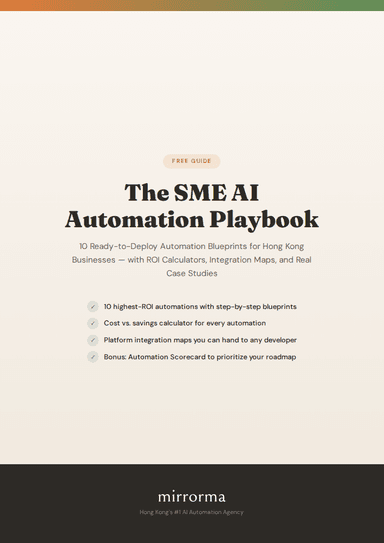
Stop Guessing. Start Automating.
Get the exact blueprints, ROI calculators, and integration maps behind 10 proven automations — the same playbook we use to save Hong Kong businesses 10-20 hours every week. Calculate your savings before you spend a dollar.
Instant download. No spam. Unsubscribe anytime.
Join 500+ Hong Kong business owners
3. Implement Localized Guardrails
For Hong Kong SMEs, localization means more than translation. It means configuring the AI to recognize FPS payment confirmations, Octopus card refund timelines, and local public holiday impacts on delivery schedules. You also set strict guardrails: if confidence drops below a threshold, or if the query involves sensitive data like credit card details or medical product inquiries, the AI immediately escalates to a live agent with a full conversation transcript. This keeps your brand voice professional and your liability minimal.
Practical Steps to Deploy AI That Actually Works
If you want AI customer service automation that resolves most problems without human intervention, skip the plug-and-play widgets and follow this implementation framework:
- Audit Query Volume and Complexity: Export three months of support tickets. Categorize them by intent. You will quickly discover that 60 to 70 percent of inquiries follow predictable patterns that are perfect for automation.
- Centralize and Clean Your Documentation: Consolidate shipping policies, product manuals, warranty terms, and FAQs into a single, version-controlled repository. Remove outdated information before ingestion.
- Deploy a Secure RAG Pipeline: Use a platform that supports document chunking, semantic search, and source verification. Never train a model on raw customer data; keep your operational knowledge separate and encrypted.
- Connect to Live Systems via APIs: Integrate with your order management, carrier tracking, and payment gateways. Real-time data retrieval is what separates a helpful assistant from a guessing game.
- Define Escalation Triggers and Fallbacks: Set clear rules for when the AI should stop and hand over. Log every fallback reason to continuously improve the knowledge base.
- Monitor, Measure, Iterate: Track resolution rate, customer satisfaction, and average handling time. Run weekly prompt refinements based on actual conversation logs, not assumptions.
Ready to Automate Without Losing Your Brand Voice?
AI customer service in 2026 does not replace your team. It liberates them. When your AI handles routine tracking questions, bilingual inquiries, and standard policy clarifications, your staff can focus on high-value customer relationships, complex problem-solving, and business growth. The technology exists. The execution strategy is what separates successful deployments from expensive experiments.
At Mirrorma, we design and engineer AI automation specifically for Hong Kong SMEs. We do not sell generic chatbot templates. We audit your workflows, centralize your knowledge, build secure RAG pipelines, and integrate directly with your existing tools. If you are tired of bots that guess and ready for automation that actually resolves, book a free discovery call with our engineering team today. Let us show you how your customer service can scale, without scaling your headcount.
Ready to automate your business?
Book a free 20-minute strategy call to see how we can save you hours every week.
Book a Free Call