AI Social Media for HK SMEs: Consistent, On-Brand, Agency-Free
The Social Media Trap: Why HK SMEs Are Burning Out
If you are running a small or medium-sized enterprise in Hong Kong, social media probably feels like a necessary but exhausting obligation. You know you need to maintain an active presence on LinkedIn, Instagram, and WeChat. Your competitors are posting consistently. Prospective clients expect thought leadership, company updates, and industry insights. Yet, between managing daily operations, handling client deliverables, and navigating Hong Kong’s fast-paced commercial environment, dedicating ten to fifteen hours every week to content creation is simply unsustainable. This is the exact dilemma thousands of local business owners face daily. You are caught between the prohibitive costs of traditional marketing agencies and the reality of doing it yourself while wearing multiple operational hats.
Artificial intelligence has emerged as the obvious answer. It promises scale, speed, and relentless consistency. But does it actually deliver content that sounds like your company, or does it flood your feed with robotic, generic noise? The market is already saturated with businesses that tried generic AI tools and ended up damaging their credibility. The truth is that AI can absolutely handle your social media without an agency, but only when you treat it as a structured automation system rather than a magic drafting button. The difference between a forgettable AI post and a brand-building piece of content comes down to three pillars: explicit voice documentation, workflow architecture, and strategic human oversight. Let us break down how to build this system for a Hong Kong SME context.
The Agency Dilemma and the Generic AI Problem
Why Traditional Retainers Do Not Fit HK SMEs
Hong Kong’s commercial landscape is highly competitive, and operational costs remain among the highest in Asia. Engaging a full-service digital agency typically requires a monthly retainer between fifteen thousand and thirty-five thousand HKD. For established corporations, this is a standard line item. For a lean SME, it often consumes a significant portion of your net profit margin. Furthermore, agencies operate on standardized playbooks designed for scalability, not boutique authenticity. While they deliver polished visuals and scheduled posts, they rarely capture the nuanced expertise of a specialized consultancy, a niche logistics provider, or a family-run retail brand. You end up paying premium rates for content that sounds interchangeable with your competitors, which defeats the entire purpose of building a distinct digital presence.
When AI-Generated Content Becomes a Liability
This brings us to the second major pitfall: the unguided DIY approach. Many founders paste a handful of bullet points into a public large language model and expect ready-to-publish copy. The output is painfully predictable. The tone is flat, the insights lack depth, and it completely misses the cultural and commercial context that Hong Kong audiences expect. When your social feed reads like it was assembled by a generic writing engine, trust erodes. Potential clients scroll past. Engagement stagnates. Lead generation stalls. AI is not the problem; unstructured implementation is. Without a dedicated pipeline, you will only automate inefficiency and amplify generic messaging across multiple platforms.
How to Build an AI Social Engine That Actually Sounds Like You
The solution requires moving beyond basic prompting and designing a custom automation workflow that captures your brand’s DNA and deploys it at scale. At Mirrorma, we approach this as an operational engineering challenge. Here is how you structure it for sustainable results.
Step One: Codify Your Brand Voice Before Automating
AI cannot intuitively guess your tone. It requires explicit, structured instructions. Start by documenting your brand voice guidelines. What is your core industry expertise? Do you communicate in a conversational, approachable manner, or do you lean into formal, data-driven analysis? How do you address bilingual audiences? What are your non-negotiables regarding compliance, regional business etiquette, or technical terminology? Compile these parameters into a centralized knowledge base. When your automation system references this material, it stops generating marketing fluff and starts producing content that aligns with your actual operational expertise. You are not asking AI to be creative; you are asking it to execute your established standards consistently.
Step Two: Design a Batch-Generation and Scheduling Pipeline
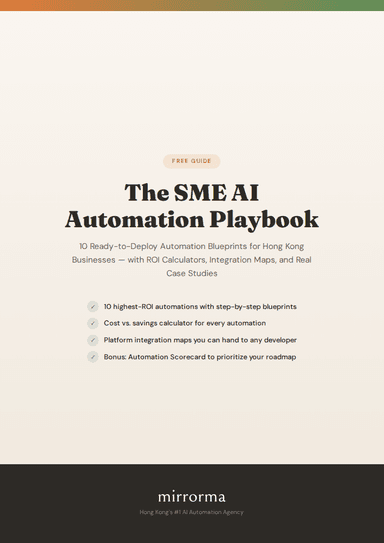
Stop Guessing. Start Automating.
Get the exact blueprints, ROI calculators, and integration maps behind 10 proven automations — the same playbook we use to save Hong Kong businesses 10-20 hours every week. Calculate your savings before you spend a dollar.
Instant download. No spam. Unsubscribe anytime.
Join 500+ Hong Kong business owners
Consistency always outperforms sporadic bursts of effort. Instead of drafting posts day-by-day, architect a workflow that generates a month’s worth of content in a single focused session. Your system should pull from three primary sources: recent industry developments, internal project insights, and evergreen educational pillars. Use AI to draft platform-specific captions, suggest contextual hashtags, outline carousel structures, and generate visual briefs for your design resources. Once drafted, route the content directly into your scheduling dashboard. This eliminates the daily cognitive load of deciding what to post and frees your leadership team for high-value strategic work. The automation handles volume; you handle direction.
Step Three: Implement the Human-in-the-Loop Review
Automation never means abandonment. The most resilient SME setups include a mandatory human review checkpoint. Before any asset goes live, a designated team member should verify factual accuracy, adjust local market references, and ensure the messaging aligns with current business priorities or upcoming campaigns. This step typically requires five to ten minutes per week per platform but guarantees brand safety and contextual relevance. AI handles the heavy lifting of drafting, formatting, and structuring. Your team adds the final layer of authenticity and commercial judgment. This hybrid model consistently outperforms both fully manual production and completely autonomous posting.
Practical Takeaways for Immediate Implementation
If you want to transition from theory to execution, start with these actionable steps designed specifically for resource-constrained HK SMEs that demand measurable outcomes.
- Build a Content Pillar Framework: Define three to four core topics that directly align with your service offerings. For example, a business consultancy might focus on regulatory compliance updates, operational efficiency frameworks, leadership development, and anonymized client success stories. AI thrives when given clear boundaries and structured input.
- Repurpose Existing Internal Assets: You already possess valuable insights buried in team meetings, client correspondence, and internal reports. Use AI transcription and summarization pipelines to convert those raw materials into LinkedIn thought leadership articles, Instagram carousel scripts, and short-form video outlines. One hour of internal knowledge can fuel weeks of scheduled content.
- Localize for the Hong Kong Market: Global AI models frequently default to Western business trends and generic corporate speak. Configure your prompts to emphasize regional context. Explicitly reference Hong Kong-specific compliance standards, bilingual communication preferences, local economic indicators, and cross-border commercial dynamics. This immediately differentiates your presence from international competitors and builds local credibility.
- Measure Quality Metrics, Not Just Output Volume: Do not evaluate success by the number of posts published. Track engagement rate, profile visits, direct message inquiries, and lead conversion velocity. AI should optimize for business outcomes, not vanity metrics. Review performance monthly, identify high-performing themes, and refine your automation prompts accordingly.
Ready to Automate Without Losing Your Brand’s Soul?
Artificial intelligence is no longer an experimental novelty. It is a foundational operational infrastructure. The SMEs that dominate the next decade will not be the ones who avoid automation, nor will they be the ones who blindly outsource to traditional agencies. They will be the businesses that architect intelligent, customized content pipelines that scale their expertise without scaling their overhead.
At Mirrorma, we specialize in designing and deploying these exact systems for Hong Kong small and medium enterprises. We do not sell generic prompt templates or one-size-fits-all dashboards. We engineer end-to-end content automation workflows that integrate seamlessly with your existing tech stack, preserve your unique brand voice, and deliver transparent, measurable ROI. If you are exhausted from choosing between expensive retainers and unsustainable DIY creation, it is time to install a smarter operating system for your marketing.
Reach out to the Mirrorma team today for a complimentary AI workflow audit. We will map out precisely how your social media production, content distribution, and client engagement can be automated effectively and safely. Stop trading hours for posts. Start building an intelligent engine that works around the clock to position your brand as an industry authority.
Ready to automate your business?
Book a free 20-minute strategy call to see how we can save you hours every week.
Book a Free Call