Self-Hosted vs Cloud Automation: The Real Cost for HK SMEs
The $5 VPS Illusion: Why Self-Hosted Automation Isn’t Always Cheaper
If you’ve been browsing tech forums or watching automation tutorials lately, you’ve probably seen the same pitch: “Skip the monthly subscription fees. Spin up a cheap VPS, install n8n or a similar open-source platform, and run your entire workflow stack for under ten dollars a month.” On a spreadsheet, it looks like an undeniable win. For Hong Kong SMEs operating on tight margins, saving hundreds of dollars monthly on software licensing is incredibly tempting. But here’s the reality we’ve encountered after architecting and managing dozens of automation systems for local businesses: the sticker price rarely tells the full story.
Business automation isn’t just about connecting app A to app B. It’s about reliability, data security, ongoing maintenance, and the hidden operational costs of keeping a complex system running smoothly in a fast-paced market. When we strip away the marketing hype and look at actual total cost of ownership (TCO), the question shifts from “Which option is cheaper on day one?” to “Which approach saves more money over twelve months?” Let’s break it down with real numbers and local context.
The Hidden Costs of Self-Hosting for Hong Kong SMEs
Self-hosting gives you full control, but control comes with operational responsibility. Here’s what most cost-comparison spreadsheets conveniently leave out:
1. The Real Financial Impact of Downtime
When your managed cloud automation platform experiences an outage, you’re usually covered by enterprise-grade service level agreements. When your self-hosted VPS goes offline at two in the morning because of a memory leak, a failed operating system update, or an exhausted disk quota, your order confirmations stop sending, your inventory sync halts, and your customer support workflows break. For a Hong Kong retail, F&B, or e-commerce SME, even four hours of downtime during a weekend promotion can wipe out months of supposed server savings. Lost revenue compounds faster than subscription fees.
2. Maintenance Becomes a Hidden Part-Time Job
Running n8n, PostgreSQL, Redis, reverse proxies, and container orchestration isn’t a set-and-forget operation. You need to manage automated backups, monitor server health, apply security patches, rotate API keys, clear execution logs, and troubleshoot failed nodes. If you don’t have an in-house DevOps engineer, this burden falls on your already stretched IT generalist, operations manager, or even your founder. In Hong Kong’s competitive labor market, that time has a high opportunity cost. Every hour spent debugging Docker containers is an hour not spent optimizing sales pipelines or improving customer retention.
3. Security and PDPO Compliance Overheads
Hong Kong’s Personal Data (Privacy) Ordinance requires businesses to implement reasonable security measures when handling personal information. A budget VPS shared with unknown tenants, lacking automated firewall rules, intrusion detection, encrypted storage, or routine vulnerability scans, introduces significant compliance risk. Configuring enterprise-grade security from scratch takes specialized expertise. If your automation workflows process customer contact details, payment records, employee data, or vendor invoices, the financial and reputational cost of a single data leak or audit failure will instantly dwarf any monthly subscription you avoided.
4. Scaling Is Rarely Linear
Self-hosted infrastructure works perfectly fine at low execution volumes. But as your business grows, so does your compute demand. Suddenly, you’re upgrading RAM, managing load balancers, optimizing database indexing, and dealing with third-party API rate limits. Cloud platforms handle this automatically, charging incrementally for what you actually use. Self-hosting forces you to overprovision hardware upfront to avoid bottlenecks, or accept performance degradation during peak operational hours.
When Cloud Automation Actually Pays Off
Paid cloud platforms aren’t just selling you convenience; they’re selling you predictability and operational resilience. Here’s where the math starts to clearly favor SaaS for most Hong Kong SMEs:
- Zero Infrastructure Overhead: No server provisioning, no backup scheduling, no SSL certificate renewals, no kernel patching. Your team focuses purely on workflow logic and business outcomes.
- Built-in Monitoring and Alerting: Cloud dashboards track execution times, error rates, payload sizes, and API failures out of the box. You don’t need to stitch together open-source monitoring tools just to know if a critical workflow broke at midnight.
- Team Collaboration and Version Control: Enterprise cloud tiers include role-based access control, audit trails, environment staging, and deployment pipelines. This is critical for SMEs where multiple staff interact with the same automation stack.
- Dedicated Vendor Support: When something breaks, you have a formal ticketing system and technical support SLAs, not a community forum thread. For mission-critical operations, that guaranteed response time has real financial value.
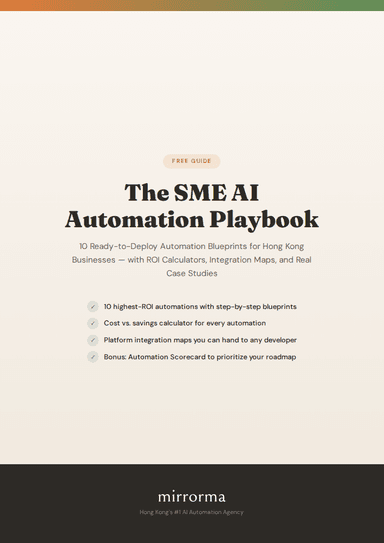
Stop Guessing. Start Automating.
Get the exact blueprints, ROI calculators, and integration maps behind 10 proven automations — the same playbook we use to save Hong Kong businesses 10-20 hours every week. Calculate your savings before you spend a dollar.
Instant download. No spam. Unsubscribe anytime.
Join 500+ Hong Kong business owners
A Practical Framework for HK SMEs
So, should you self-host or go cloud? It’s not a binary choice. Use this decision matrix to evaluate your specific operational reality:
Choose Self-Hosting If:
- You have a dedicated technical lead with proven DevOps and infrastructure experience.
- Your workflows process highly sensitive data that cannot legally or contractually leave your private network.
- You’re running predictable, low-volume tasks where compute costs remain negligible over time.
- You’re fully prepared to treat infrastructure maintenance as an ongoing, billable operational expense.
Choose Cloud Automation If:
- Your team lacks specialized server management skills or needs to focus on core revenue activities.
- You need rapid iteration, frequent workflow updates, and seamless integration with modern SaaS tools.
- Downtime directly impacts cash flow, order fulfillment, or customer satisfaction.
- You prefer predictable monthly operating expenses over unpredictable emergency troubleshooting.
Practical Takeaways: How to Calculate Your Real TCO
Before committing to either path, run this internal audit to eliminate guesswork:
- Map Your Monthly Maintenance Hours: Estimate how many hours per week your team will spend updating, securing, and troubleshooting the system. Multiply by your blended internal hourly rate.
- Quantify Downtime Impact: Calculate the average revenue loss for every hour your automation stack is offline. Be realistic, not optimistic.
- Audit Compliance Requirements: List the security controls, encryption standards, and audit logs you’d need to implement manually versus what a cloud provider includes by default.
- Project Twelve-Month Growth: Will your workflow volume double? Triple? Cloud scales with you automatically; self-hosting requires architecture re-planning and hardware procurement.
When you run these numbers honestly, most Hong Kong SMEs discover that the “cheap” VPS route actually costs thirty to fifty percent more annually once hidden labor, downtime risk, and compliance mitigation are factored in. Cloud automation isn’t a luxury; it’s an operational efficiency multiplier that protects your team’s time and your business’s reputation.
The Middle Path: Managed Automation Infrastructure
You don’t have to choose between losing control and losing sleep. Many forward-thinking Hong Kong SMEs are adopting a hybrid approach: they design their workflows in flexible, open-source platforms, but they run them on managed, secure, and professionally monitored infrastructure. This gives you the architectural freedom of self-hosting without the maintenance burden. Automated backups, enterprise security, dedicated technical oversight, and predictable billing come without the DevOps tax.
Let Mirrorma Handle the Automation Plumbing
At Mirrorma, we’ve spent years building, deploying, and optimizing AI automation systems for Hong Kong SMEs across retail, logistics, professional services, and finance. We’ve seen both sides of this debate firsthand, and we’ve helped dozens of businesses transition from fragile DIY setups to reliable, scalable, and cost-effective automation stacks.
Our managed automation services give you the best of both worlds: the flexibility of modern workflow tools, the reliability of enterprise-grade cloud infrastructure, and the strategic oversight of an expert partner that understands the Hong Kong market. We handle the servers, security, monitoring, and integrations so your team can focus entirely on growth, customer experience, and operational excellence.
Stop guessing whether self-hosting is actually saving you money. Book a free automation architecture review with Mirrorma today. We’ll analyze your current workflows, map out your true TCO, and deliver a scalable solution tailored to your exact business needs. Let’s build automation that works as hard as you do.
Ready to automate your business?
Book a free 20-minute strategy call to see how we can save you hours every week.
Book a Free Call